
Western Sydney Airport's first passenger flight leaves for the Gold Coast on Sunday
By Michal Zembol
Published .
Jetstar flight JQ362, an Airbus A320, is scheduled to depart Western Sydney International at 11am on 25 October. Freight has used the curfew-free airport since July. Air New Zealand's first Auckland service is due the next morning.
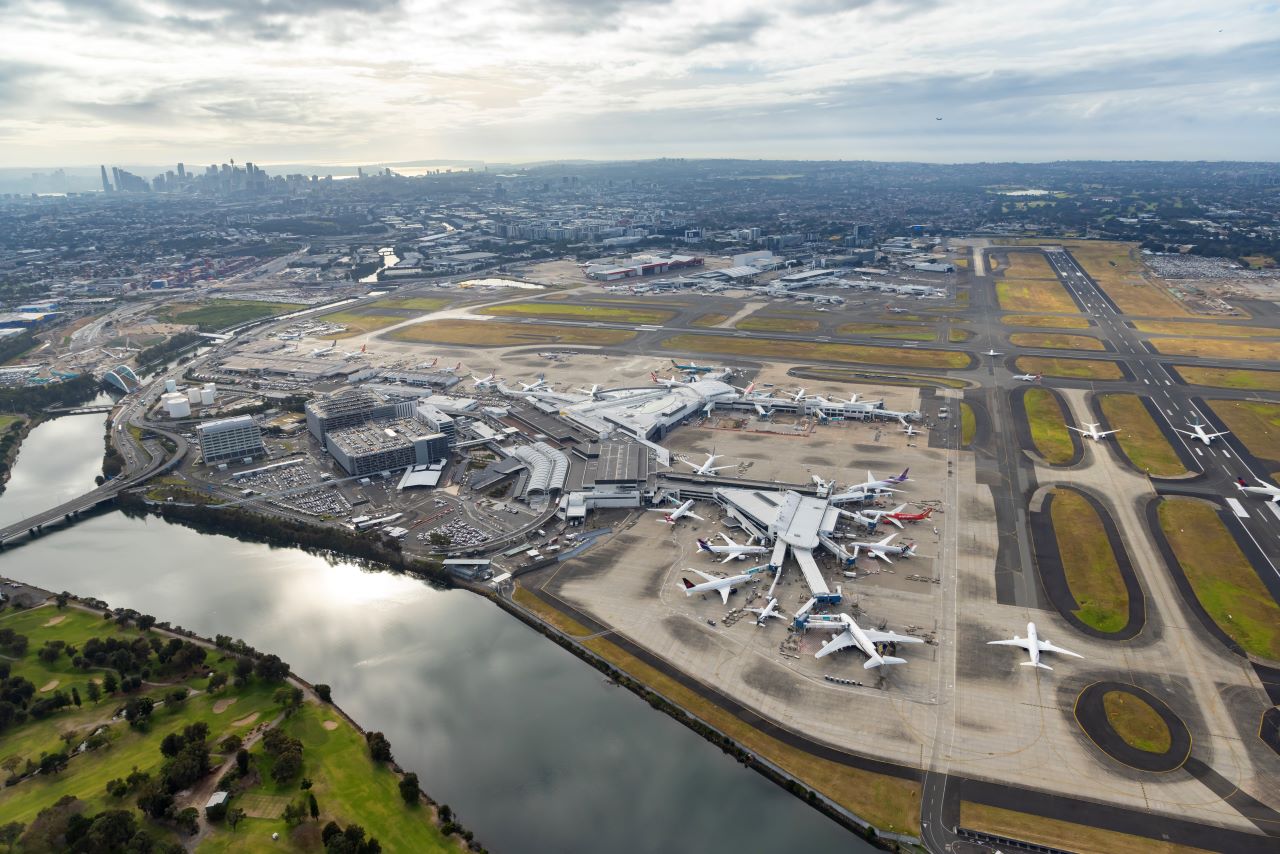
Passenger flying starts at Western Sydney International (Nancy-Bird Walton) Airport on Sunday 25 October 2026. The first commercial passenger departure is Jetstar flight JQ362, an Airbus A320 due to leave for the Gold Coast at 11am. The Prime Minister's office set out that flight and time on 10 June. The infrastructure minister has since described JQ362 as sold out. The airport is not opening to aircraft for the first time on Sunday. Freight operations began on 26 July, and Qantas Freight's first departure was the following evening.
The terminal is at Badgerys Creek and Luddenham. In a 2023 information paper to the International Civil Aviation Organization, Australian officials placed it about 44 kilometres from the Sydney central business district and about 41 kilometres from Sydney (Kingsford Smith) Airport. Airlines are using the code WSI. The airport takes the name of Nancy-Bird Walton, who started flying lessons at Mascot in 1933 with Charles Kingsford Smith and later worked as a commercial pilot. Construction began in September 2018. On 10 June 2026 the Prime Minister's office described the project as 15 years of planning, seven years of building and a year of testing.
Who is flying in the first months
Jetstar's published opening pattern is up to 14 flights a week between WSI and Melbourne, four a week to the Gold Coast and three a week to Brisbane, all on the A320. Qantas has said its own passenger flights start on 28 March 2027: four QantasLink services a week to Melbourne and four to Brisbane, on Monday, Wednesday, Friday and Sunday, flown by Embraer E190s. In its June announcement Qantas said the WSI flying was still subject to regulatory approval, and that the new services sit on top of its Kingsford Smith timetable. The Prime Minister's office has given the same Jetstar and Qantas dates as the operating plan.
Air New Zealand is the first international carrier on the programme. From Monday 26 October it plans three return flights a week to Auckland, on Monday, Wednesday and Friday, with A320 and A321 aircraft. In a statement on 17 July the airline set the Auckland departure at 6:00am, arriving at WSI at 7:45am, with the return leaving WSI at 8:55am and reaching Auckland at 2:10pm.
Singapore Airlines has published a daily Airbus A350-900 from 23 November 2026. Through 27 March 2027, SQ201 leaves Singapore at 11:30am and lands at WSI at 10:20pm. SQ202 leaves WSI at 11:55pm and arrives in Singapore at 5:05am the next day. The airline says that medium-haul A350 has 303 seats, 40 in business class and 263 in economy. Its March release said the route was subject to regulatory approval. In June the Prime Minister's office said the daily flights would start on 23 November. Singapore Airlines already operates four daily flights to Kingsford Smith, and said the WSI service would take that to five.
Routes announced for 2027
Three more airlines have published start dates after the opening season. None of them is on the board for Sunday.
- Vietjet, from January 2027: two flights a week to Ho Chi Minh City on A330s with up to 377 seats, rising to three a week in March. The Prime Minister's office said that on 10 August 2026. It also said Vietjet Thailand plans four flights a week to Bangkok from November 2027, and that those Bangkok services were still subject to regulatory approval.
- Fiji Airways, from Friday 19 March 2027: three flights a week, on Monday, Friday and Sunday, on the Boeing 737 MAX 8. The airline's timetable shows FJ991 leaving Nadi at 7:10pm and arriving at WSI at 10:55pm, and FJ990 leaving WSI at 11:55pm and arriving in Nadi at 4:55am. Fiji Airways says the times can change during daylight saving.
- Qatar Airways, from 15 December 2027: three flights a week on the Boeing 777-300ER, with 42 business seats and 312 economy seats. The airline says tickets go on sale on 19 December 2026. Its published pattern is QR906 from Doha at 1:40am, arriving at WSI at 11:45pm on Monday, Wednesday and Friday, and QR907 from WSI at 4:10pm, arriving in Doha at 11:00pm on Tuesday, Thursday and Saturday. Qatar Airways says it intends to build the route up to a daily flight. That increase is not a published timetable.
What the curfew difference allows
Kingsford Smith is under a curfew from 11pm to 6am, set by the Sydney Airport Curfew Act 1995. In those hours most aircraft cannot take off or land. The shut-down is not total. Emergency flights may use the airport, and the department can grant a dispensation. Some propeller aircraft are allowed if they meet the noise tests and stay at or below 34,000 kilograms maximum take-off weight. The same weight limit applies to jets, but only to types named in the Sydney Airport Curfew (Curfew Aircraft) Instrument 2015. The Act also allows a limited number of BAe 146 freight movements each week. International passenger aircraft have a separate shoulder rule. The shoulder is 11pm to midnight and 5am to 6am. In it, the regulations allow up to 24 landings a week between 5am and 6am, with no more than five on one day, and no international passenger take-offs.
WSI has no curfew. Several of the international timings already published fall in hours a normal Kingsford Smith schedule cannot use. Singapore Airlines' 11:55pm departure, Fiji Airways' 11:55pm departure and Qatar Airways' 11:45pm arrival are all inside the Kingsford Smith curfew. Sunday's Gold Coast flight, at 11am, does not depend on that difference. The night hours matter for the later long-haul timings, and for freight.
Kingsford Smith is also capped. The Sydney Airport Demand Management Act 1997 limits it to 80 aircraft movements in a regulated hour, a 60-minute block used to measure the cap, and to 1,360 movements a day outside the curfew. After a serious disruption a recovery period can allow 85 movements an hour for up to two hours. That higher rate cannot be used during the curfew, and the day still cannot go past 1,360. WSI is not under those limits. Qantas has said its WSI flights are additional to Kingsford Smith, so they are extra movements in the Sydney basin, not a reshuffle of the capped airport.
A legal switch at Kingsford Smith is timed for the week after passengers start. The Prime Minister's office said 1 November 2026 is the intended date for gazetting WSI as available for night movements. The infrastructure department says that once the minister makes that declaration, the Kingsford Smith exceptions for freight, propeller aircraft and small jets come to an end. The Prime Minister's office said the freight flights now allowed overnight at Kingsford Smith would stop, while emergencies and special dispensations would continue. Until that declaration is made, those Kingsford Smith exceptions remain in the Act.
Buses first, metro later
No train will reach the terminal on Sunday. The Sydney Metro Western Sydney Airport line is a 23-kilometre railway from St Marys to Bradfield, with stations at the airport business park and the terminal. The infrastructure department says it is still to be finished, and that a free bus covers the gap. Transport for NSW calls that bus WSI Link. It runs between St Marys station and the airport every 30 minutes, from 4:30am to midnight Sunday to Thursday, and from 4:30am to 1am on Friday and Saturday. It is fare-free. Other buses run every 30 minutes from 5am to 10pm to Penrith, Mount Druitt, Liverpool and Campbelltown, and those need an Opal card or a contactless bank card.
The bus hours do not match a 24-hour airport. WSI Link stops at midnight midweek, so it does not serve the whole night in which a late departure can operate. Road access does. The M12, a toll-free 16-kilometre motorway from the M7 near Cecil Hills to The Northern Road at Luddenham, opened in March 2026. The airport says tickets are on sale for a direct shuttle to Parramatta, the Sydney CBD and Sydney Airport, and that Uber pick-up starts on 25 October from a zone about 100 metres from the terminal.
One runway, controlled from Eastern Creek
The same 2023 paper to ICAO described the first stage as a single runway of 3,700 metres, designated 05/23, able to take Code F aircraft, with a Category III instrument landing system at each end. Code F covers the largest current airliners, those with a wingspan from 65 metres up to, but not including, 80 metres, including the Airbus A380. Category III equipment is what allows landings in very low visibility. Officials put the site at 1,780 hectares and said the opening layout was expected to handle up to 10 million passengers a year. The Prime Minister repeated that 10 million figure in June 2026. The paper also said a second runway was planned for when the first reached its limit, which officials then expected around 2050. That year was a planning estimate.
There is no control tower on the airport for controllers to sit in. On 7 July 2026 the Civil Aviation Safety Authority issued instrument CASA 29/26, approving Airservices Australia to provide aerodrome control through an Advanced Digital Tower. The remote centre is at Eastern Creek, and the equipment on the airport is a camera mast. In 2023, Australian officials told ICAO this would be the first controlled aerodrome in Australia built without a physical tower. The ABC has reported Airservices chief executive Robert Sharp describing about 25 high-definition cameras on the mast, including cameras that can follow an aircraft and infrared sensors for poor visibility, with the controllers about 20 kilometres from the runway.
The cargo precinct is already in use. The infrastructure minister has said its first stage can take up to eight wide-body freighters, such as 747s, or 16 narrow-body freighters at the same time, and that it is intended to handle up to 1.8 million tonnes of cargo a year. The minister named Qantas Freight, Menzies Aviation, dnata and Texel Air as users. The Prime Minister's office said the whole airport project had involved more than 12,800 jobs, about half of them local, and more than $500 million of construction spending with more than 360 Western Sydney businesses. Those are government figures for the build, not a count of airline jobs once flying starts.