
NTSB preliminary report describes the 21 Air 767 overrun at Miami
By Michal Zembol
Published . Developing story. Details below distinguish what organisations have confirmed from claims that are still under investigation.
The 1 October report says flight 7598, a Boeing 767 freighter for Amazon, crossed the Miami runway threshold at 177 knots and touched down about 3,750 feet farther on. Five people on the ground were killed on 6 September. The investigation is open and the report does not state a cause.
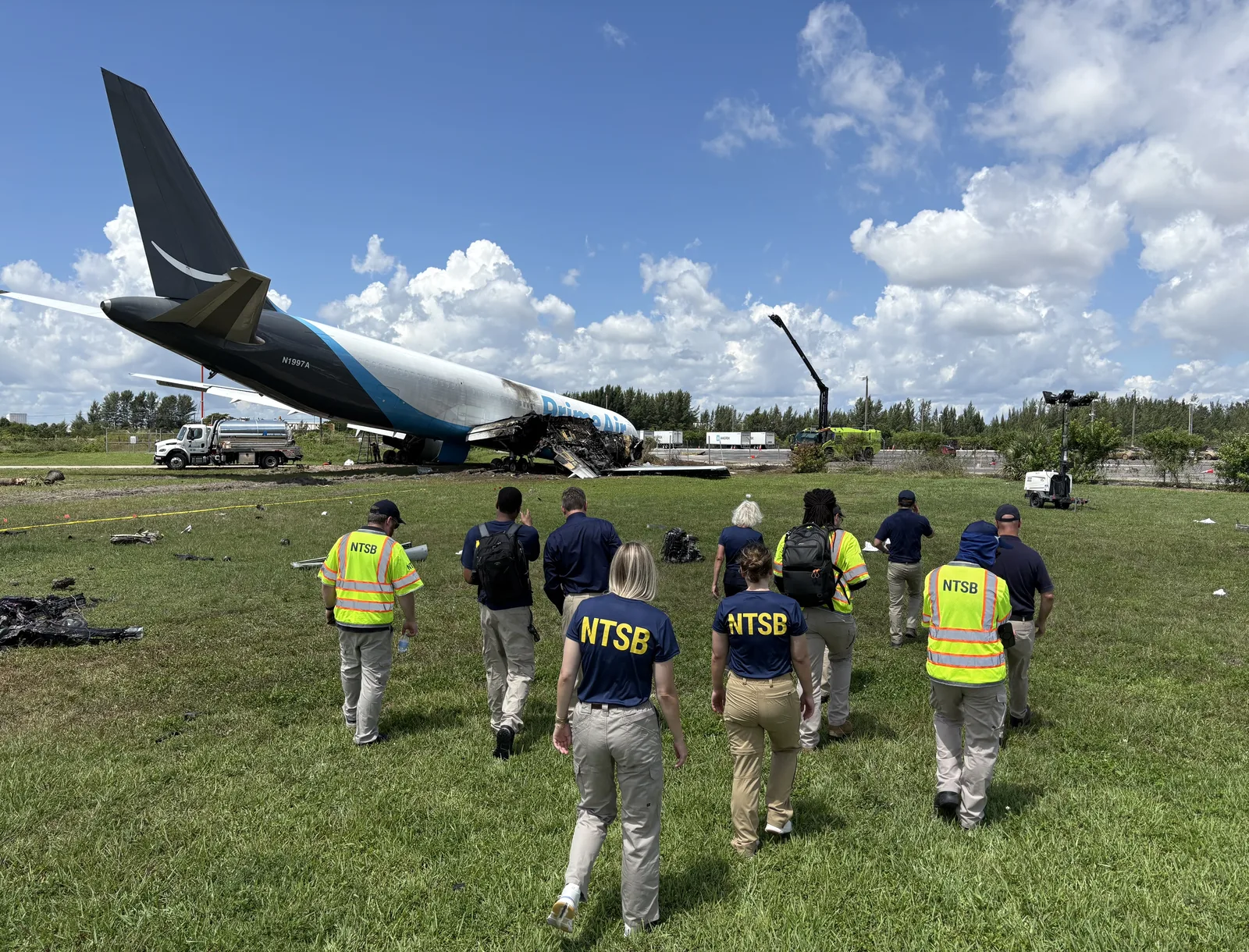
On 1 October 2026 the National Transportation Safety Board published a preliminary report on 21 Air flight 7598. The Boeing 767-33A, registration N1997A, was a Part 121 cargo flight for Amazon.com Services from San Juan to Miami International Airport. On 6 September, at about 13:53 local time, it landed on runway 30, left the pavement, and hit two vehicles. Both pilots had minor injuries. Five people on the ground were killed and three were seriously hurt. The right wing had a fire after the crash. The investigation number is DCA26MA352. The report does not give a probable cause, and the NTSB says the investigation is still open.
The airplane was cleared to land at about 13:49, when it was about 12 nautical miles from the displaced threshold of runway 30. Flight data and broadcast surveillance show it then crossed the threshold of runway 30 about 105 feet above the ground, at a groundspeed of 177 knots. It touched down about 3,750 feet past the threshold at about 160 knots. Tyre marks from the left and right main gear start about 3,750 and 3,820 feet from the threshold. The airplane crossed the far end of the runway at 113 knots, hit the localizer and the approach lights at about 100 knots, and came to rest about 1,200 feet beyond the paved surface. The last recorded groundspeed was 65 knots, shortly after it hit the airport fence and crossed NW 67th Avenue.
Before the fence, the airplane hit a Ford Econoline van on a perimeter road. Five of the seven people in the van were killed and two were seriously hurt. On the public road it hit a Toyota Corolla Cross. The only person in that vehicle was seriously hurt. The captain left through the forward left door. The first officer left through the right cockpit window. Miami firefighters answered with five airport rescue vehicles, and other departments were called after that.
What the recorders show
The cockpit voice recorder and the flight data recorder were recovered and read in Washington. On the voice recording, with flaps called to 20 degrees, the first officer cautioned that they were too fast and kept commenting on the speed. The report says there was not a consistent verbal reply. The automated calls included "sink rate" and, four times, "too low terrain." About 15 seconds before the recording ended, the captain called for a go-around. About 10 seconds before the end, the recording has a sound like the airplane leaving the pavement.
The data recorder shows the speed brakes stayed stowed and the thrust reversers did not deploy during the landing or the rollout. The crew applied the wheel brakes manually at 146 knots. About eight seconds later, at 120 knots, the brakes were released and both throttles moved to go-around thrust. About 930 feet of runway remained. About four seconds after that, at 117 knots, the throttles came back to idle and the brakes went on again, with about 415 feet of runway left. The weight-on-wheels signal switched between air and ground for about seven seconds, then stayed on ground with about 2,730 feet of runway remaining. The NTSB says a performance study will refine this sequence. These figures are from the preliminary report, not a finished reconstruction.
In the cockpit the flap lever was found in the 25-degree detent, and measurements of the slats and flaps matched a 25-degree setting. During the approach the captain had called for 30 degrees. The thrust levers were at idle, the fuel switches were at cut-off, and both engine fire handles were pulled and turned. The thrust-reverser levers were in the first detent and the speed-brake lever was stowed. The report gives those as the positions found in the cockpit.
Wind and the landing clearance
The airport's automated weather report at 13:53 gave wind from 190 degrees at 17 knots, gusting to 26, with thunderstorms, cumulonimbus cloud at 2,000 feet and a broken ceiling at 4,800 feet. A report three minutes earlier had 16 knots gusting to 24 from the same direction. At 13:37 the system had logged a wind shift. The peak wind of that hour, at 13:52, was from 180 degrees at 26 knots. Earlier in the hour, at 13:13, the wind was variable at 3 knots, already with thunderstorms.
The local controller cleared flight 7598 to land and did not give the wind. The NTSB cites FAA Order JO 7110.65BB, which requires both wind direction and speed when a controller authorises a runway that has a tailwind component. About four minutes earlier, asked by a different flight, the same controller had said the wind was from 190 degrees at 19 knots, gusting to 22. Flight 7598 was not on that frequency yet. The preliminary report states these facts. It does not find that the missing wind call caused the overrun.
Runway 12/30 is 150 feet wide and 9,360 feet long, a length that includes the displaced threshold for runway 30. There is no engineered-materials arresting bed at the end of runway 30. The flight was the airplane's third of the day and the crew's second together. They had flown the same 767 from Miami to San Juan that morning. On the accident leg the captain was flying and the first officer was monitoring. In interviews with investigators the captain reported about 7,267 hours, about 150 of them on the 767, after joining 21 Air in April 2026. The first officer reported about 2,800 hours, about 800 of them on the 767, after joining in February 2025. Those totals are what the pilots told the NTSB.
Boeing built the airplane in June 1994 as a passenger aircraft. It was converted to a freighter in June 2016 and is powered by GE CF6 engines. It had about 110,077 flight hours and 24,505 cycles. 21 Air, based operationally in Miami, had 22 aircraft at the time, a mix of 757s and 767s. Parties to the investigation include the FAA, Boeing, GE Aerospace, 21 Air, the Miami-Dade Aviation Department, the controllers' union and the 21 Air pilots' association. The NTSB says the work continues.